In calculus, the (ε, δ)-definition of limit ("epsilon-delta definition of limit") is a formalization of the notion of limit. It was first given byBernard Bolzano in 1817. Augustin-Louis Cauchy never gave an ( ) definition of limit in his Cours d'Analyse, but occasionally used arguments in proofs. The definitive modern statement was ultimately provided by Karl Weierstrass.
) definition of limit in his Cours d'Analyse, but occasionally used arguments in proofs. The definitive modern statement was ultimately provided by Karl Weierstrass.History
Isaac Newton was aware, in the context of the derivative concept, that the limit of the ratio of evanescent quantities was not itself a ratio, as when he wrote:
- Those ultimate ratios ... are not actually ratios of ultimate quantities, but limits ... which they can approach so closely that their difference is less than any given quantity...
Occasionally Newton explained limits in terms similar to the epsilon-delta definition. Augustin-Louis Cauchy gave a definition of limit in terms of a more primitive notion he called a variable quantity. He never gave an epsilon-delta definition of limit (Grabiner 1981). Some of Cauchy's proofs contain indications of the epsilon-delta method. Whether or not his foundational approach can be considered a harbinger of Weierstrass's is a subject of scholarly dispute. Grabiner feels that it is, while Schubring (2005) disagrees. Nakane concludes that Cauchy and Weierstrass gave the same name to different notions of limit.
Informal Statement
Let f be a function. To say that

means that f(x) can be made as close as desired to L by making the independent variable x close enough, but not equal, to the value c.
How close is "close enough to c" depends on how close one wants to make f(x) to L. It also of course depends on which function f is and on which number c is. Therefore let the positive number ε (epsilon) be how close one wishes to make f(x) to L; strictly one wants the distance to be less than ε. Further, if the positive number δ is how close one will make x to c, and if the distance from x to c is less than δ (but not zero), then the distance from f(x) to L will be less than ε. Therefore δ depends on ε. The limit statement means that no matter how small ε is made, δ can be made small enough.
The letters ε and δ can be understood as "error" and "distance", and in fact Cauchy used ε as an abbreviation for "error" in some of his work. In these terms, the error (ε) in the measurement of the value at the limit can be made as small as desired by reducing the distance (δ) to the limit point.
This definition also works for functions with more than one argument. For such functions, δ can be understood as the radius of a circle or a sphere or some higher-dimensional analogy centered at the point where the existence of a limit is being proven, in the domain of the function and, for which, every point inside maps to a function value less than εaway from the value of the function at the limit point.
Precise Statement
The  definition of the limit of a function is as follows:
definition of the limit of a function is as follows:
Let  be a function defined on a subset
  , let
, let  be a limit point of
  , and let
  be a real number. Then
be a function defined on a subset , let be a limit point of , and let be a real number. Then- the function
 has a limit at
is defined to mean
- for all
 , there exists a
  such that for all
  in that satisfy
  , the inequality
  holds.
Symbolically:

Example
PROBLEM 1 : Prove that

Begin by letting
 be given. Find
  so that if
  , then
  , i.e.,
  , i.e.,
  . But this trivial inequality is always true, no matter what value is chosen for
  . For example,
  will work. Thus, if , then it follows that . This completes the proof.
PROBLEM 2 : Prove that

Begin by letting
be given. Find (which depends on  ) so that if
  , then . Begin with and ``solve for"
 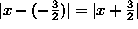 . Then, iff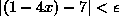
iff 
iff 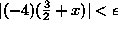
iff 
iff 
iff  .
.
Now choose . . Thus, if
  , it follows that . This completes the proof.
PROBLEM 3 : Prove that
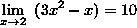
Begin by letting
be given. Find (which depends on ) so that if  , then
 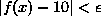 . Begin with and ``solve for" | x - 2 | . Then, iff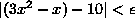
iff 
iff  .
.
We will now ``replace" the term |3x+5| with an appropriate constant and keep the term |x-2| , since this is the term we wish to ``solve for". To do this, we will arbitrarily assume that . (This is a valid assumption to make since, in general, once we find a that works, all smaller values of also work.) . Then
 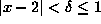 implies that -1 < x-2 < 1 and 1 < x < 3 so that 8 < |3x+5| < 14 (Make sure that you understand this step before proceeding.). It follows that (Always make this ``replacement" between your last expression on the left and . This guarantees the logic of the proof.)
iff 
iff  .
.
Now choose .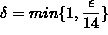 (This guarantees that both assumptions made about in the course of this proof are taken into account simultaneously.). Thus, if , it follows that . This completes the proof.
Source:
https://en.wikipedia.org/wiki/(%CE%B5,_%CE%B4)-definition_of_limit
https://www.math.ucdavis.edu/~kouba/CalcOneDIRECTORY/preciselimdirectory/PreciseLimit.html

Tidak ada komentar:
Posting Komentar