Vodka is a drink which originated in Eastern Europe, the name stemming from the Russian word 'voda' meaning water or, as the Poles would say 'woda'.
The first documented production of vodka in Russia was at the end of the 9th century, but the first known distillery at, Khylnovsk, was about two hundred years later as reported in the Vyatka Chronicle of 1174. Poland lays claim to having distilled vodka even earlier in the 8th century, but as this was a distillation of wine it might be more appropriate to consider it a crude brandy. The first identifiable Polish vodkas appeared in the 11th century when they were called 'gorzalka', originally used as medicines.
Medicine & Gunpowder
During the Middle Ages, distilled liquor was used mainly for medicinal purposes, as well as being an ingredient in the production of gunpowder. In the 14th century a British emissary to Moscow first described vodka as the Russian national drink and in the mid-16th century it was established as the national drink in Poland and Finland. We learn from the Novgorod Chronicles of 1533 that in Russia also, vodka was used frequently as a medicine (zhiznennia voda meaning 'water of life').
In these ancient times Russia produced several kinds of 'vodka' or 'hot wine' as it was then called. There was 'plain wine' (standard), 'good wine' (improved) and 'boyar wine' (high quality). In addition stronger types existed, distilled two ('double wine') or more times.
Since early production methods were crude, vodka often contained impurities, so to mask these the distillers flavoured their spirits with fruit, herbs or spices.
The mid - 15th century saw the first appearance of pot distillation in Russia. Prior to that, seasoning, ageing and freezing were all used to remove impurities, as was precipitiation using isinglass ('karluk') from the air bladders of sturgeons. Distillation became the first step in producing vodka, with the product being improved by precipitation using isinglass, milk or egg white.
Around this time (1450) vodka started to be produced in large quantities and the first recorded exports of Russian vodka were to Sweden in 1505. Polish 'woda' exports started a century later, from major production centres in Posnan and Krakow.
From acorns to melon
 In 1716, owning distilleries became the exclusive right of the nobility, who were granted further special rights in 1751. In the following 50 or so years there was a proliferation of types of aromatised vodka, but no attempt was made to standardise the basic product. Types produced included; absinthe, acorn, anisette, birch, calamus root, calendula, cherry, chicory, dill, ginger hazelnut, horseradish, juniper, lemon, mastic, mint, mountain ash, oak, pepper, peppermint, raspberry, sage, sorrel, wort and water melon! A typical production process was to distil alcohol twice, dilute it with milk and distil it again, adding water to bring it to the required strength and then flavouring it, prior to a fourth and final distillation. It was not a cheap product and it still had not attained really large-scale production. It did not seek to compete commercially with the major producers in Lithuania, Poland and Prussia.
In the 18th century a professor in St. Petersburg discovered a method of purifying alcohol using charcoal filtration. Felt and river sand had already been used for some time in Russia for filtration.
Vodka marches accross Europe
The spread of awareness of vodka continued throughout the 19th century, helped by the presence in many parts of Europe of Russian soldiers involved in the Napoleonic Wars. Increasing popularity led to escalating demand and to meet this demand, lower grade products were produced based largely on distilled potato mash.
Earlier attempts to control production by reducing the number of distilleries from 5,000 to 2,050 between the years 1860 and 1890 having failed, a law was enacted in 1894 to make the production and distribution of vodka in Russia a state monopoly. This was both for fiscal reasons and to control the epidemic of drunkenness which the availability of the cheap, mass-produced 'vodkas' imported and home-produced, had brought about.
It is only at the end of the 19th century, with all state distilleries adopting a standard production technique and hence a guarantee of quality, that the name vodka was officially and formally recognised.
After the Russian Revolution, the Bolsheviks confiscated all private distilleries in Moscow. As a result, a number of Russian vodka-makers emigrated, taking their skills and recipes with them. One such exile revived his brand in Paris, using the French version of his family name - Smirnoff. Thence, having met a Russian émigré from the USA, they set up the first vodka distillery there in 1934. This was subsequently sold to a US drinks company. From this small start, vodka began in the 1940s to achieve its wide popularity in the Western World.


 definition of the limit of a function is as follows:
 be a function defined on a subset
  , let
, let  be a limit point of
  , and let
  be a real number. Then
 has a limit
  , there exists a
  such that for all
  in
in  , the inequality
  holds.

 be given. Find
  so that if
  , then
  , i.e.,
  , i.e.,
  . But this trivial inequality is always true, no matter what value is chosen for
  . For example,
  will work. Thus, if
 ) so that if
  , then
  . Then,




 .
. . Thus, if
  , it follows that
 , then
  . Begin with

 .
. (This is a valid assumption to make since, in general, once we find a
  implies that -1 < x-2 < 1 and 1 < x < 3 so that 8 < |3x+5| < 14 (Make sure that you understand this step before proceeding.). It follows that (Always make this ``replacement" between your last expression on the left and

 .
.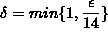 (This guarantees that both assumptions made about