Minggu, 29 Mei 2016

Voltaire Biography

Nicolas de Largillière, François-Marie Arouet dit Voltaire (vers 1724-1725) -001.jpg  

Portrait by Nicolas de Largillière, c. 1724
BornFrançois-Marie Arouet
21 November 1694
ParisFrance
Died30 May 1778 (aged 83)
Paris, France
Pen nameVoltaire
OccupationWriter, philosopher, playwright, historian
NationalityFrench

Synopsis

Born on November 21, 1694, in Paris, France, Voltaire was exiled to Tulle in 1715. Two years later, in 1717, he returned to Paris, only to be arrested and exiled to the Bastille for a year. He was sent to the Bastille again in 1726, before being shipped off to England. In 1733, he fled to Lorraine, and in 1759, he wrote the satirical novella Candide. In 1778, Voltaire returned to Paris, where he died there on May 30 of that year.

Early Life

Widely considered one of France's greatest Enlightenment writers, Voltaire was born François-Marie Arouet to an upper-middle class family on November 21, 1694, in Paris, France. He was the youngest of five children born to François Arouet and Marie Marguerite Daumand. When Voltaire was just 7 years old, his mother passed away. Following her death, he grew closer to his free-thinking godfather.
In 1704, Voltaire began to show promise as a writer while receiving a classical education at the Collége Louis-le-Grand, a Jesuit secondary school in Paris.

Major Works

Voltaire's major fall into four categories: poetry, plays, historical works and philosophical works. His most well-known poetry includes the epic poemsHenriade (1723) and The Maid of Orleans, which he started writing in 1730, but never fully completed.
Among the earliest of Voltaire's best-known plays is the tragedy Oedipus, which was first performed in 1718. Voltaire followed Oedipus with a string of dramatic tragedies, including Mariamne (1724). His Zaïre (1732), written in verse, was something of a departure from his previous tragedies. Until that point, Voltaire's tragedies had centered on a fatal flaw in the protagonist's character; the tragedy in Zaïre was the result of circumstance. FollowingZaïre, Voltaire continued to write tragic plays, including Mahomet in 1736 andNanine in 1749.
Voltaire's body of writing also includes the notable historical works The Age of Louis XIV (1751), and Essay on the Customs and the Spirit of the Nations(1756). In Essay on the Customs and the Spirit of the Nations, Voltaire took a unique approach to tracing the progression of world civilization by focusing on social history and the arts.
Voltaire's popular philosophic works took the form of the short storiesMicromégas (1752) and Plato's Dream (1756), along with his famed satirical novella Candide (1759). In 1764, he published another of his most important philosophical works, Dictionnaire philosophique, an encyclopedic dictionary embracing the concepts of Enlightenment and rejecting the ideas of the Roman Catholic Church.

Arrests and Exiles

In 1715, Voltaire was exiled to Tulle for mocking the regent Orleans. In 1717, he returned to Paris, only to be arrested and exiled to the Bastille for a year on charges of writing libelous poetry. Voltaire was sent to the Bastille again in 1726, for arguing with the Chevalier de Rohan (Guy Auguste de Rohan-Chabot). He was detained there for two weeks before being shipped off to England, where he would remain for the next three years.
In 1733, the publication of Voltaire's Letters on the English Nation angered the French church and government, forcing the writer to flee to Lorraine. He remained there for the next 15 years with his mistress, Emile de Breteuil, at the Château de Cirey, visiting Paris occasionally as of 1735, when he was granted re-entry. By 1778, the French public had begun to regard Voltaire as a literary genius, and he returned to Paris a hero.

Death

Two months before his death, the ailing Voltaire bid the crowd farewell at a production of his play Irene: "I die adoring God, loving my friends, not hating my enemies, and detesting superstition." Voltaire died in his sleep on May 30, 1778, in Paris, France.
Source:

ETER

PENGERTIAN ETER

Eter adalah senyawa karbon turunan alkana yang memiliki gugus fungsi –OR’ (alkoksi). Eter dikenal dengan alkoksi alkana.

RUMUS UMUM ALKANA

Eter (alkoksi alkana) dianggap berasal dari substitusi satu atom H pada alkana dengan gugus fungsi –OR. Simak beberapa senyawa alkoksi alkana berikut.
Tabel beberapa senyawa alkoksi alkana
NamaStrukturRumus Molekul
Metoksimetana (dimetil eter)CH3 – O – CH3C2H6O
Etoksietana (dietil eter)C2H5 – O – C2H5C4H10O
Metoksietana (etil metil eter)CH3 – O – CH3C3H8O
Dari rumus molekul senyawa – senyawa di atas, jika n adalah jumlah atom C,maka rumus umum alkoksi alkana dinyatakan sebagai:
CnH2n+2O
Struktur alkoksi alkana juga dapat dilihat sebagai suatu atom O yang diapit oleh dua gugus alkil, R dan R’, yang dapat sama atau berbeda. Oleh karena itu, rumus di atas dapat ditulis sebagai:
R – O – R’
R dan R’ adalah gugus alkil yang dapat sama atau berbeda
Berdasarkan R dan R’, alkoksi alkana dapat digolongkan menjadi:
  1. Alkoksi alkana tunggal/ sederhana, yakni alkoksi alkana dengan dua gugus alkil yang simetris, yakni R = R’. Contohnya adalah dimetil alkoksi alkana (CH3 – O – CH3).
  2. Alkoksi alkana majemuk, yakni alkoksi alkana dengan dua gugus alkil yang asimetris, R ≠ R’. Contohnya adalah etil metil alkoksi alkana (CH3 – O – C2H5).

TATA NAMA ETER

Penamaan senyawa eter dapat dilakukan dengan dua cara, yaitu penamaan dengan alkil eter (trivial, atau nama umum) dan alkoksi alkana (IUPAC).
  1. TATA NAMA TRIVIAL

Pada tata nama eter secara trivial, nama kedua gugus alkil disebutkan lebih dulu, kemudian diikuti kata eter. Bila gugus alkilnya berbeda maka nama alkil diurutkan berdasarkan abjad, tapi bila kedua gugus alkilnya sama maka diberiawalan di-. Sebagai contoh, perhatikan struktu berikut.
CH3 – O – CH3 dimetil eter (R = R’)
 CH3 – O – CH2 – CH3 etil metil eter (R ≠ R’)
C2H5 – O – C3H7 etil propil eter (R ≠ R’)
  1. TATA NAMA IUPAC

Pada tata nama IUPAC, bila gugus alkilnya mempunyai jumlah rantai C yang tidak sama maka alkil yang bertindak sebagai alkoksi (R – O) adalah alkil dengan jumlah C yang lebih kecil,kemudian diikuti nama rantai alkananya (R). Bila digambarkan, cara penamaan tersebut adalah sebagai berikut:
eter - tatanama Eter IUPAC
CH3 – O – CH3      metoksi metana
 CH3 – O – CH2 – CH3       metoksi etana
CH3 – CH– O – CH2 – CH2 – CH3       etoksi propana

SIFAT ETER

Ada dua sifat eter yang akan dibahas, yaitu sifat fisika eter dan sifat kimia eter (reaksi eter).
  1. SIFAT FISIKA ETER

Alkoksi alkana merupakan cairan tidak berwarna yang mudah menguap dan terbakar, serta berbau enak tetapi mempunyai  sifat membius. Titik didih Alkoksi alkana realtif lebih rendah jika dibandingkan dengan isomer gugus fungsinya, alkohol, yang setara (memiliki jumlah atom C sama) karena di dalam alkohol terdapat ikatan hidrogen, sedangkan pada Alkoksi alkana tidak (adanya gaya London, yang lebih lemah dari ikatan hidrogen).
  1. SIFAT KIMIA ETER / REAKSI ETER

Alkoksi alkana kurang reaktif karena gugus fungsinya yang kurang reaktif. Berikut beberapareaksi eter:
a. Reaksi dengan PCl5
reaksi alkoksi alkana dengan fosfor penta klorida akan menghasilkan alkil halida. Reaksi dengan PCl5 dapat digunakan untuk membedakan alkohol dengan alkoksi alkana. Pada alkohol dihasilkan HCl yangd apat memerahkan lakmus biru, sedangkan alkoksi alkana tidak.
R – O – R’ + PCl5 → RCl + R’Cl + POCl3
Contoh:
CH3 – O – C2H5 + PCl5 → CH3Cl + C2H5Cl + PCl3
b. Reaksi dengan asam halida (HX)
Eter dapat bereaksi dengan asamhalida (terutama HI) menghasilkan alkil halida dan alkohol.
R – O – R’ + HI → R – OH + R’ – I
Jika asam halidanya berlebih, akan dihasilkan 2 molekul alkil halida.
Contoh:
C2H5 – O – CH3 + HI → C2H5 – OH + CH3 – I
CH3 – O – C2H5 + 2HI → CH3 – I + C2H5 – I + H2O

PEMBUATAN ETER

  1. Alkoksi alkana simetris dibuat dari dehidrasi alkohol menggunakan asam sulfat pekat pada suhu 140oC.
2R – OH → R – O – R + H2O   (H2SO4, 140oC)
Contoh:
2CH3 – OH → CH3 – O – CH3 + H2O     (H2SO4, 140oC)
  1. Reaksi antara Na – alkoksida dengan alkil halida (sintesis Williamson)
R – ONa + R’Cl → R – O – R’ + NaCl
Contoh:
CH3CH2ONa + CH3Cl → CH3CH2 – O – CH3 + NaCl

KEGUNAAN ETER

1. Dietil eter
  1. Sebagai pelarut senyawa organik untuk ekstraksi senyawa organik dari air atau pelarut lainnya. Banyak senyawa organik yang lebih mudah larut dalam dietileter dibandingkan dengan air. Dengan titik didih yang rendah, dietileter dapat dipisahkan kembali dari senyawa – senyawa organik terlarutnya melalui penyulingan pada suhu rendah.
  2. Sebagai obat bius (anestesi). Campuran dietileter dengan air bersifat sangat eksplosif sehingga sekarang telah diganti dengan zat lain, seperti pentrana (CH3 – O – CF2 – CHCl2) dan entrana (CHF2 – O – CF2 – CHFCl).
2. Metil tersier butil eter (MTBE atau 2-metil-2-metoksi propana)
MTBE berperan sebagai zat aditif pada bensin. MTBE bersifat karsinogenik dan kebocoran MTBE dari tempat penyimpanan bensin di tangki bawah tanah, dapat mencemari air tanah. Penggunaan MTBE telah dilarang dan kemudian akan digunakan senyawa yang mengandung oksigen, seperti etanol yang tidak terlalu karsinogenik meski agak mahal.

Beberapa eter penting

Struktur kimia dari etilena oksidaEtilena oksidaEter siklik yang paling sederhana.
Struktur kimia dari dimetil eterDimetil eterMerupakan propelan pada aerosol. Merupakan bahan bakar alternatif yang potensial untuk mesin diesel karena mempunyai bilangan cetan sebesar 56-57.
Struktur kimia dari dietil eterDietil eterMerupakan pelarut umum pada suhu rendah (b.p. 34.6 °C), dan dulunya merupakan zat anestetik. Digunakan sebagai cairan starter kontak pada mesin diesel.
Struktur kimia dari dimetoksimetanaDimetoksimetana(DME)Pelarut pada suhu tinggi (b.p. 85 °C):
Struktur kimia dari dioksanaDioksanaMerupakan eter siklik dan pelarut pada suhu tinggi (b.p. 101.1 °C).
Struktur kimia dari THFTetrahidrofuran (THF)Eter siklik, salah satu eter yang bersifat paling polar yang digunakan sebagai pelarut.
Struktur kimia dari anisolAnisol(metoksibenzena)Merupakan eter aril dan komponen utama minyak esensial pada biji adas manis.
Struktur kimia dari 18-crown-6Eter mahkotaPolieter siklik yang digunakan sebagai katalis transfer fase.
Struktur kimia dari polietilen glikolPolietilen glikol(PEG)Merupakan polieter linear, digunakan pada kosmetik dan farmasi.
Sumber:

Rabu, 23 Maret 2016

History Of Vodka

Vodka is a drink which originated in Eastern Europe, the name stemming from the Russian word 'voda' meaning water or, as the Poles would say 'woda'. 
The first documented production of vodka in Russia was at the end of the 9th century, but the first known distillery at, Khylnovsk, was about two hundred years later as reported in the Vyatka Chronicle of 1174. Poland lays claim to having distilled vodka even earlier in the 8th century, but as this was a distillation of wine it might be more appropriate to consider it a crude brandy. The first identifiable Polish vodkas appeared in the 11th century when they were called 'gorzalka', originally used as medicines. 

Medicine & Gunpowder

During the Middle Ages, distilled liquor was used mainly for medicinal purposes, as well as being an ingredient in the production of gunpowder. In the 14th century a British emissary to Moscow first described vodka as the Russian national drink and in the mid-16th century it was established as the national drink in Poland and Finland. We learn from the Novgorod Chronicles of 1533 that in Russia also, vodka was used frequently as a medicine (zhiznennia voda meaning 'water of life'). 

In these ancient times Russia produced several kinds of 'vodka' or 'hot wine' as it was then called. There was 'plain wine' (standard), 'good wine' (improved) and 'boyar wine' (high quality). In addition stronger types existed, distilled two ('double wine') or more times. 

Since early production methods were crude, vodka often contained impurities, so to mask these the distillers flavoured their spirits with fruit, herbs or spices. 

The mid - 15th century saw the first appearance of pot distillation in Russia. Prior to that, seasoning, ageing and freezing were all used to remove impurities, as was precipitiation using isinglass ('karluk') from the air bladders of sturgeons. Distillation became the first step in producing vodka, with the product being improved by precipitation using isinglass, milk or egg white. 

Around this time (1450) vodka started to be produced in large quantities and the first recorded exports of Russian vodka were to Sweden in 1505. Polish 'woda' exports started a century later, from major production centres in Posnan and Krakow. 


From acorns to melon

In 1716, owning distilleries became the exclusive right of the nobility, who were granted further special rights in 1751. In the following 50 or so years there was a proliferation of types of aromatised vodka, but no attempt was made to standardise the basic product. Types produced included; absinthe, acorn, anisette, birch, calamus root, calendula, cherry, chicory, dill, ginger hazelnut, horseradish, juniper, lemon, mastic, mint, mountain ash, oak, pepper, peppermint, raspberry, sage, sorrel, wort and water melon! A typical production process was to distil alcohol twice, dilute it with milk and distil it again, adding water to bring it to the required strength and then flavouring it, prior to a fourth and final distillation. It was not a cheap product and it still had not attained really large-scale production. It did not seek to compete commercially with the major producers in Lithuania, Poland and Prussia. 

In the 18th century a professor in St. Petersburg discovered a method of purifying alcohol using charcoal filtration. Felt and river sand had already been used for some time in Russia for filtration. 

Vodka marches accross Europe

The spread of awareness of vodka continued throughout the 19th century, helped by the presence in many parts of Europe of Russian soldiers involved in the Napoleonic Wars. Increasing popularity led to escalating demand and to meet this demand, lower grade products were produced based largely on distilled potato mash. 

Earlier attempts to control production by reducing the number of distilleries from 5,000 to 2,050 between the years 1860 and 1890 having failed, a law was enacted in 1894 to make the production and distribution of vodka in Russia a state monopoly. This was both for fiscal reasons and to control the epidemic of drunkenness which the availability of the cheap, mass-produced 'vodkas' imported and home-produced, had brought about. 

It is only at the end of the 19th century, with all state distilleries adopting a standard production technique and hence a guarantee of quality, that the name vodka was officially and formally recognised. 

After the Russian Revolution, the Bolsheviks confiscated all private distilleries in Moscow. As a result, a number of Russian vodka-makers emigrated, taking their skills and recipes with them. One such exile revived his brand in Paris, using the French version of his family name - Smirnoff. Thence, having met a Russian émigré from the USA, they set up the first vodka distillery there in 1934. This was subsequently sold to a US drinks company. From this small start, vodka began in the 1940s to achieve its wide popularity in the Western World.

Source: http://www.ginvodka.org/history/vodkaHistory.asp

Definition Of Limit

(ε, δ)-definition of limit
In calculus, the (ε, δ)-definition of limit ("epsilon-delta definition of limit") is a formalization of the notion of limit. It was first given byBernard Bolzano in 1817. Augustin-Louis Cauchy never gave an (\varepsilon,\delta) definition of limit in his Cours d'Analyse, but occasionally used \varepsilon,\deltaarguments in proofs. The definitive modern statement was ultimately provided by Karl Weierstrass.


History
Isaac Newton was aware, in the context of the derivative concept, that the limit of the ratio of evanescent quantities was not itself a ratio, as when he wrote:
Those ultimate ratios ... are not actually ratios of ultimate quantities, but limits ... which they can approach so closely that their difference is less than any given quantity...
Occasionally Newton explained limits in terms similar to the epsilon-delta definition. Augustin-Louis Cauchy gave a definition of limit in terms of a more primitive notion he called a variable quantity. He never gave an epsilon-delta definition of limit (Grabiner 1981). Some of Cauchy's proofs contain indications of the epsilon-delta method. Whether or not his foundational approach can be considered a harbinger of Weierstrass's is a subject of scholarly dispute. Grabiner feels that it is, while Schubring (2005) disagrees. Nakane concludes that Cauchy and Weierstrass gave the same name to different notions of limit.


Informal Statement
Let f be a function. To say that
 \lim_{x \to c}f(x) = L \,
means that f(x) can be made as close as desired to L by making the independent variable x close enough, but not equal, to the value c.
How close is "close enough to c" depends on how close one wants to make f(x) to L. It also of course depends on which function f is and on which number c is. Therefore let the positive number ε (epsilon) be how close one wishes to make f(x) to L; strictly one wants the distance to be less than ε. Further, if the positive number δ is how close one will make x to c, and if the distance from x to c is less than δ (but not zero), then the distance from f(x) to L will be less than ε. Therefore δ depends on ε. The limit statement means that no matter how small ε is made, δ can be made small enough.
The letters ε and δ can be understood as "error" and "distance", and in fact Cauchy used ε as an abbreviation for "error" in some of his work. In these terms, the error (ε) in the measurement of the value at the limit can be made as small as desired by reducing the distance (δ) to the limit point.
This definition also works for functions with more than one argument. For such functions, δ can be understood as the radius of a circle or a sphere or some higher-dimensional analogy centered at the point where the existence of a limit is being proven, in the domain of the function and, for which, every point inside maps to a function value less than εaway from the value of the function at the limit point.


Precise Statement
The (\varepsilon, \delta) definition of the limit of a function is as follows:
Let f : D \rightarrow \mathbb{R} be a function defined on a subset  D \subseteq \mathbb{R} , let c be a limit point of D, and let L be a real number. Then
the function f has a limit L at c
is defined to mean
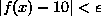
for all  \varepsilon > 0 , there exists a  \delta > 0  such that for all  x  in  D  that satisfy  0 < | x - c | < \delta , the inequality  |f(x) - L| < \varepsilon  holds.
Symbolically:
 \lim_{x \to c} f(x) = L  \iff  (\forall \varepsilon > 0)(\exists \ \delta > 0) (\forall x \in D)(0 < |x - c | < \delta \ \Rightarrow \ |f(x) - L| < \varepsilon)

Example
PROBLEM 1 : Prove that tex2html_wrap_inline157
Begin by letting tex2html_wrap_inline548 be given. Find tex2html_wrap_inline550 so that if tex2html_wrap_inline552 , then tex2html_wrap_inline554, i.e., tex2html_wrap_inline556 , i.e., tex2html_wrap_inline558 . But this trivial inequality is always true, no matter what value is chosen for tex2html_wrap_inline560. For example, tex2html_wrap_inline562 will work. Thus, if tex2html_wrap_inline552 , then it follows that tex2html_wrap_inline554 . This completes the proof.


PROBLEM 2 : Prove that tex2html_wrap_inline159
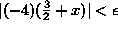
Begin by letting tex2html_wrap_inline548 be given. Find tex2html_wrap_inline550 (which depends on tex2html_wrap_inline574 ) so that if tex2html_wrap_inline610 , then tex2html_wrap_inline554. Begin with tex2html_wrap_inline554 and ``solve for" tex2html_wrap_inline616 . Then,
tex2html_wrap_inline554 iff tex2html_wrap_inline620
iff tex2html_wrap_inline622
iff tex2html_wrap_inline624
iff tex2html_wrap_inline626
iff tex2html_wrap_inline628
iff tex2html_wrap_inline630 .
Now choose tex2html_wrap_inline632 . Thus, if tex2html_wrap_inline634 , it follows that tex2html_wrap_inline554. This completes the proof.


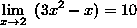
PROBLEM 3 : Prove that tex2html_wrap_inline167
Begin by letting tex2html_wrap_inline548 be given. Find tex2html_wrap_inline550 (which depends on tex2html_wrap_inline574 ) so that if tex2html_wrap_inline766 , then tex2html_wrap_inline768. Begin with tex2html_wrap_inline768 and ``solve for" | x - 2 | . Then,
tex2html_wrap_inline768 iff tex2html_wrap_inline776
iff tex2html_wrap_inline778
iff tex2html_wrap_inline780 .
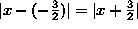
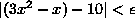
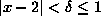
We will now ``replace" the term |3x+5| with an appropriate constant and keep the term |x-2| , since this is the term we wish to ``solve for". To do this, we will arbitrarily assume that tex2html_wrap_inline668 (This is a valid assumption to make since, in general, once we find a tex2html_wrap_inline560 that works, all smaller values of tex2html_wrap_inline560 also work.) . Then tex2html_wrap_inline792 implies that -1 < x-2 < 1 and 1 < x < 3 so that 8 < |3x+5| < 14 (Make sure that you understand this step before proceeding.). It follows that (Always make this ``replacement" between your last expression on the left and tex2html_wrap_inline574. This guarantees the logic of the proof.)

tex2html_wrap_inline802
iff tex2html_wrap_inline804
iff tex2html_wrap_inline806 .
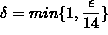
Now choose tex2html_wrap_inline808 (This guarantees that both assumptions made about tex2html_wrap_inline560 in the course of this proof are taken into account simultaneously.). Thus, if tex2html_wrap_inline766 , it follows that tex2html_wrap_inline768. This completes the proof.

Source:
https://en.wikipedia.org/wiki/(%CE%B5,_%CE%B4)-definition_of_limit
https://www.math.ucdavis.edu/~kouba/CalcOneDIRECTORY/preciselimdirectory/PreciseLimit.html